
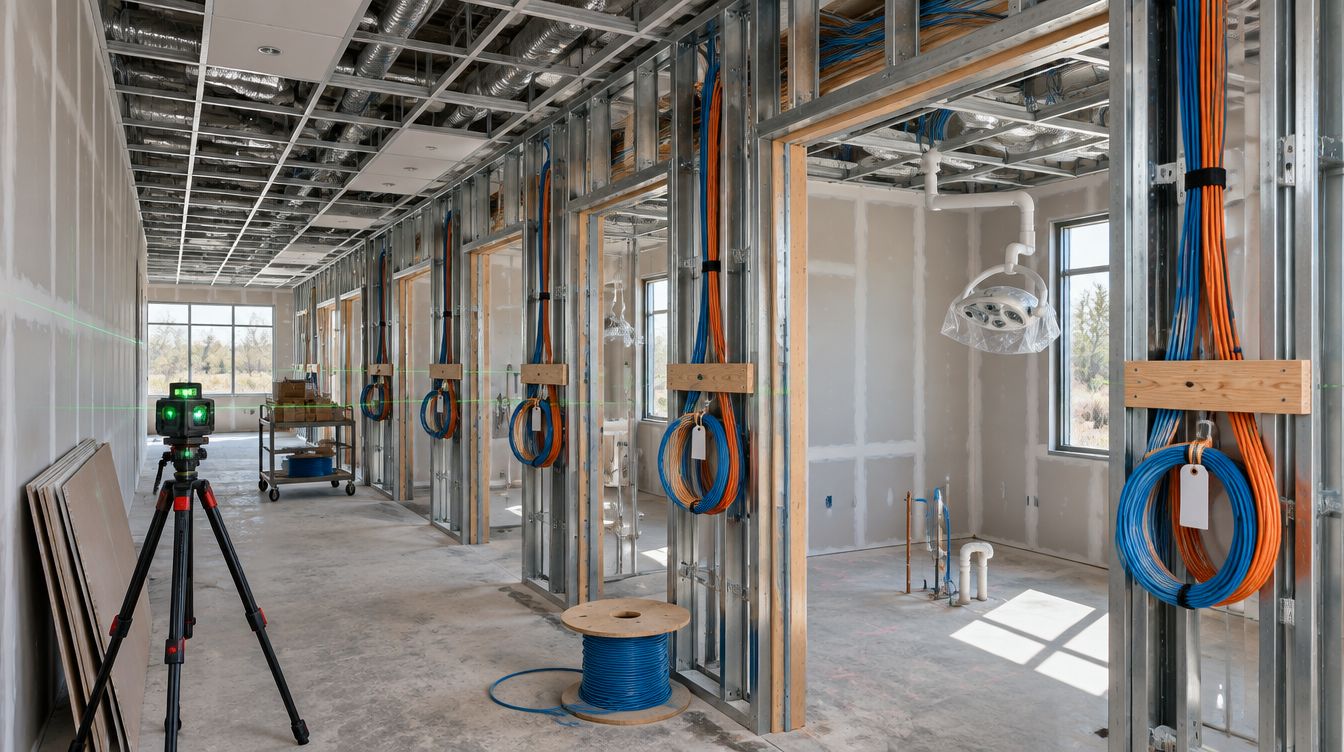
ClearMax Labs runs worthingtondentalit.com and takes on dental office buildouts across Dallas–Fort Worth. ClearMax technicians come on site for the cabling, access points and WiFi, door access, cameras, displays, server and computers, all inside one written project with a scope and an end. No monthly plan is required.
Last updated: November 2026
What does ClearMax Labs build for a practice?
- The network inside the walls: structured cabling from every operatory, the imaging room and the front desk back to one labeled patch panel.
- Coverage overhead: access points and WiFi, with the patient network kept off the clinical one.
- The doors: card or fob access on the doors that need it, planned to the fire code that applies.
- The cameras: entrances, corridors and sterilization, recording video without sound.
- Displays: planned with the rest of the buildout.
- The closet and the desks: the server, the backup, and a computer set up for each role.
Who does what on a buildout?
A dental buildout has more parties than most offices, and naming them early prevents the gap where each assumes another ordered the switch.
- The general contractor: walls, ceilings, electrical service and the overall schedule.
- The equipment dealer: chairs, sensors, imaging units and their site plans.
- The internet provider: the line into the building, which the practice orders.
- The software vendor: the dental program itself and its support desk. ClearMax Labs is not affiliated with any dental software company.
- ClearMax technicians: everything that carries data, opens a controlled door or records video, plus the server and computers, on site.
- The practice: decisions, sign-off, and every licence and account, held in its own name.
Who actually installs it, and where?
On site, across Dallas–Fort Worth. The planning happens over the floor plan and the equipment list, but the cable, the doors, the cameras, the access points and the server are installed in the building by ClearMax technicians, on the general contractor's schedule. Each city in the metro has its own permit office and fire code amendments, so the plan names the rules for the address before work starts, and inspections are booked around rough-in rather than after it.
How does a project run from first message to handover?
- The practice describes the buildout on the contact form.
- ClearMax Labs asks for whatever is missing: the floor plan, the equipment list, the door schedule, the contractor's dates.
- A written scope and quote follow, built from those details. Nothing starts until the practice agrees. If more work is needed, it is brought to the practice's attention and the bid is updated.
- The work runs on the general contractor's calendar: cabling and door wiring at rough-in, devices and computers at finish.
- Every run, door, camera and access point is tested, and the practice receives the records.
Why does every project end in paperwork?
Because the next person to open the closet, whether that is ClearMax or someone else, should start from a known state. The handover record lists every cable label, door, camera, access point, network name, the server build and the backup destinations, and it belongs to the practice.
It also matters because of what the equipment holds. Texas Business and Commerce Code 521.052(b) tells a business to destroy customer records with sensitive personal information it is not keeping, by shredding, erasing or otherwise making them unreadable. When a buildout replaces old computers or a server, those drives are wiped or destroyed and the date is written down, not left in a box in the closet. And the Texas dental board's rule, 22 TAC 108.8, keeps dental records for at least five years after the last treatment, longer for patients last seen as minors, so the record of where the old data went is worth keeping too.
None of this is legal advice. Questions about what those rules require of a particular practice belong with its own counsel.